

We’ve officially reached the halfway point of the SEC baseball season.
And now, for the first time all year, we have real information.
Five full weeks of conference play gives us a true sample size—not just of individual performances, but of how pitching staffs are being built, deployed, and trusted in high-leverage situations. You can start to see which programs are separating themselves, not just by talent, but by how they’re using that talent.
Some teams are still relying on traditional Friday–Saturday–Sunday structures. Others are mixing and matching, leaning on swing arms, or asking certain starters to simply get them through key pockets of a lineup before turning the game over.
That’s where this thing starts to evolve.
So while this week we’re locking in the Top 25 starting pitchers in the SEC, next week we’re going to zoom out and rank the entire pitching staffs 1–16, breaking down usage, depth, roles, and projecting how those staffs will hold up over the second half of the season.
Because at this point, it’s not just about who the best arms are.
It’s about which staffs are built to win series.
Top 25 SEC Starting Pitchers
1. Aidan King — Florida (↑ from No. 4)
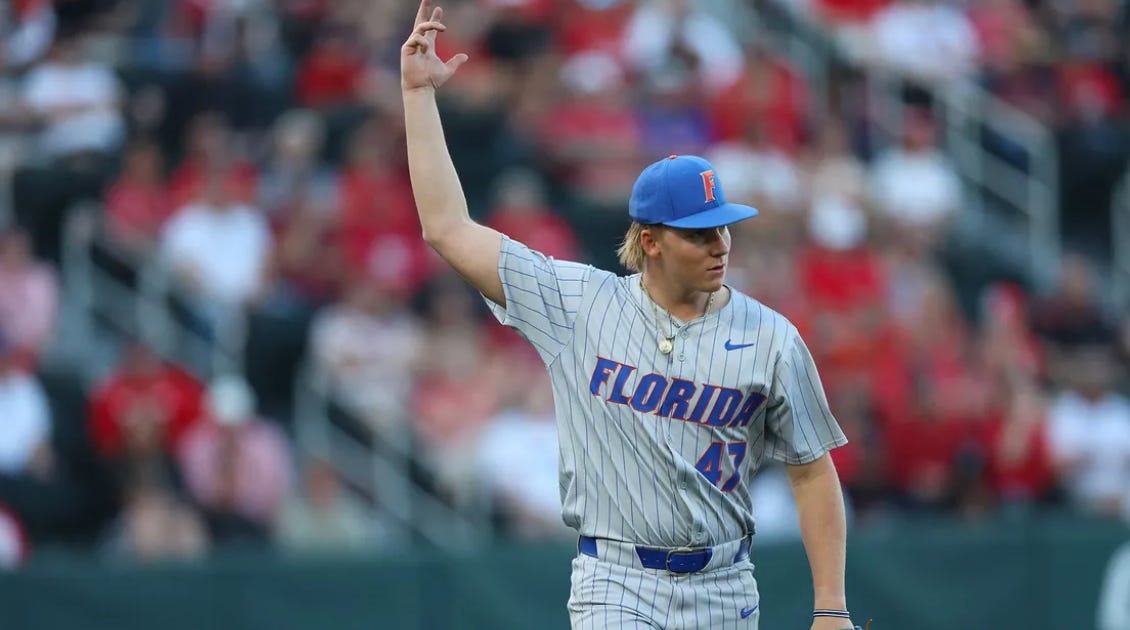
Season: 5-2, 1.74 ERA, 46.2 IP, 33 H, 47K / 11BB
Past Week: 7.2 IP, 2 H, 2 R, 2 BB, 6 K
Aidan King continued his dominance of the SEC and stepped into the Friday night role in a pivotal weekend for Florida.
Going into Athens against Georgia, in his first Friday night start of the year after moving from Saturday, he was perfect through six innings. He ended up going seven and two-thirds, allowing just two hits and two runs with two walks and six strikeouts.
On the season, he’s now 5-2 with a 1.74 ERA in 46 and two-thirds innings, allowing just 33 hits with a 47-to-11 strikeout-to-walk ratio.
He continues to look like a true stopper at the top of that rotation.
2. Andreas Alvarez — Auburn (↑ from No. 3)
Season: 6-1, 1.24 ERA, 43.2 IP, 30 H, 60K / 15BB
Past Week: 6.0 IP, 3 H, 2 R, 3 BB, 5 K
Andreas Alvarez had another solid outing and continues to show consistency every single week.
Against a good Kentucky team, in a game where Auburn gave him early run support, he went six innings, allowed just three hits and two runs, walked three, and struck out five.
On the season, he’s now 6-1 with a 1.24 ERA, and in 43 and two-thirds innings, he’s allowed just 30 hits with a 60-to-15 strikeout-to-walk ratio.
He just continues to put Auburn in position to win late in games.
3. Cade Townsend — Ole Miss (↑ from No. 7)
Season: 3-1, 2.02 ERA, 0.98 WHIP, 35.1 IP, 27 H, 54K / 8BB
Past Week: 6.0 IP, 6 H, 2 R, 1 BB, 8 K
Cade Townsend makes another jump this week and continues to put everything together.
We’ve talked about him all year—his stuff, his profile, his upside at the next level—and now the production is matching it consistently. Against LSU this weekend, he went six innings, allowed six hits and two runs, struck out eight, and walked just one.
On the year, he’s 3-1 with a 2.02 ERA, a 0.98 WHIP, and in 35 and a third innings, he’s allowed just 27 hits with a 54-to-8 strikeout-to-walk ratio.
If not for the brief injury hiccup earlier in the season, he’d be right there at the top of almost every statistical category in the SEC.
4. Jake Marciano — Auburn (↓ from No. 2)
Season: 3-2, 1.88 ERA, 0.78 WHIP, 52.1 IP, 34 H, 71K / 7BB
Past Week: 4.0 IP, 8 H, 5 R (4 ER), 0 BB, 7 K
Jake Marciano drops a bit this week, but this is one where you can’t overreact.
Even after allowing eight hits and five runs (four earned) in four innings against Kentucky, his body of work still speaks for itself. He still struck out seven and didn’t walk a batter.
On the year, he’s 3-2 with a 1.88 ERA and a 0.78 WHIP in over 52 innings. He’s allowed just 34 hits and has a 71-to-7 strikeout-to-walk ratio.
Even in his toughest outing of the year, he didn’t give free passes—just got hit a little bit. That’s the first time a team has really gotten to him, and it’s not enough to move him too far.
5. Tomas Valincius — Mississippi State (↓ from No. 1)
Season: 6-1, 1.53 ERA, 53 IP, 36 H, 72K / 12BB
Past Week: 6.0 IP, 8 H, 3 R, 1 BB, 6 K
Tomas Valincinus comes in at number five after another solid outing, even though he gave up a few more hits and runs than we’ve seen.
He went six innings, allowed eight hits and three runs, walked one, and struck out six. While that’s a step back from his usual dominance, it doesn’t change the overall profile.
On the year, he’s 6-1 with a 1.53 ERA in 53 innings, allowing just 36 hits with a 72-to-12 strikeout-to-walk ratio.
He continues to look like a true number one starter with elite stuff and a high draft profile, even as Mississippi State has struggled a bit around him.
6. Hunter Dietz — Arkansas (↑ from No. 10)
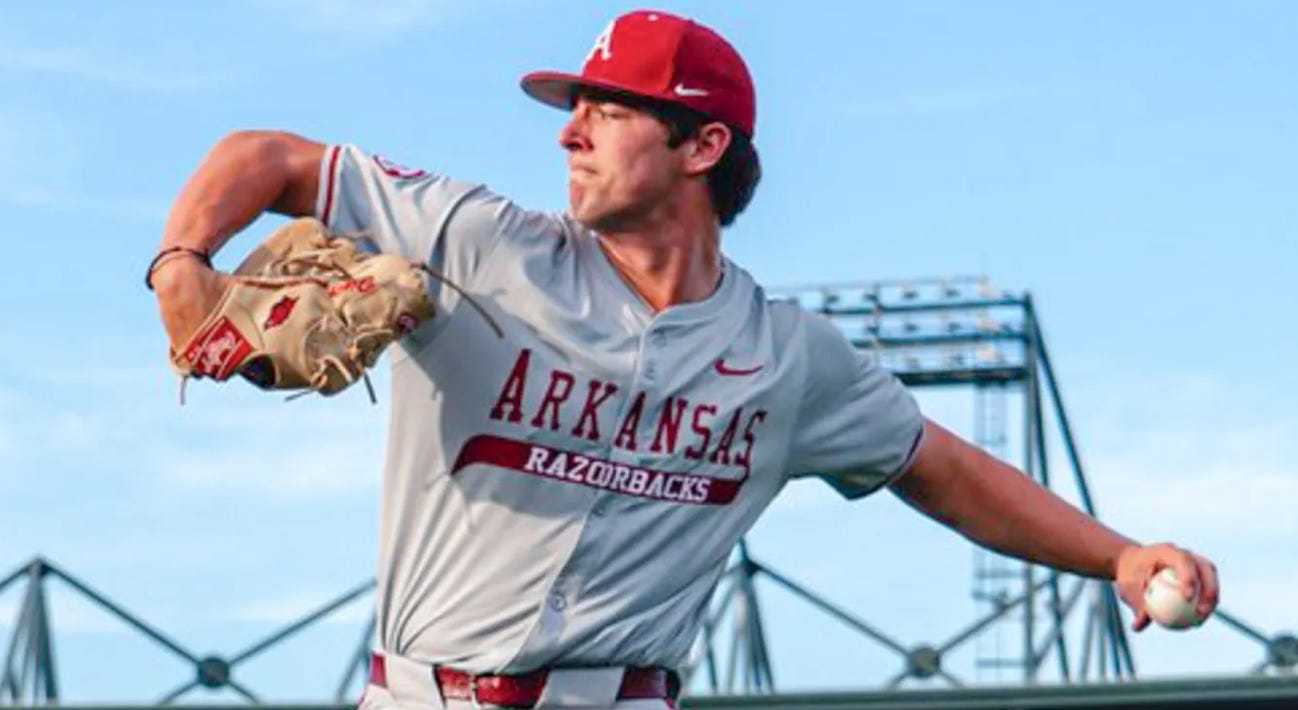
Season: 3-2, 3.61 ERA — 47.1 IP, 37 H, 78K / 17BB
Past Week: 6.0 IP, 3 H, 2 R, 3 BB, 9 K
Hunter Dietz moves into the Friday night spot for Arkansas and continues to trend in the right direction.
He’s been pretty solid all year, originally as their Saturday starter, and has been near the top of the league in strikeouts all season. We’ve never questioned the stuff—it’s always just been about whether he could command it consistently.
Now, it looks like he’s really starting to gel and put it together at the halfway point. This weekend, he went six innings, allowed three hits and two runs, walked three, and struck out nine.
On the year, he’s 3-2 in 47 and a third innings, has allowed 37 hits, and has a 78-to-17 strikeout-to-walk ratio. He’s starting to look like a true ace for Arkansas down the stretch.
7. Jaxon Jelkin — Kentucky (↓ from No. 5)
Season: 6-1, 3.38 ERA — 50.2 IP, 45 H, 57K / 13BB
Past Week: 2.0 IP, 7 H, 8 R (3 ER), 3 BB, 3 K
Jelkin drops a bit after his first real tough outing of the year.
It was a rough one—two innings, seven hits, eight runs—but even then, only three of those runs were earned. Despite that outing, the overall body of work still stands strong, and he remains one of the more impressive arms in the league.
He’s here because of that body of work, but also because of the upside. The way he carries himself, the way he competes, and the way he looks on the mound—he looks like a big leaguer every time he takes the ball.
On the year, he’s 6-1 with a 3.38 ERA in over 50 innings and continues to be a key piece for Kentucky.
8. Joey Volchko — Georgia (↑ from No. 16)
Season: 6-1, 3.38 ERA — 45.1 IP, 41 H, 49K / 21BB
Past Week: 6.0 IP, 2 H, 1 R (0 ER), 2 BB, 7 K
Joey Volchko continues to give Georgia a solid Friday night presence, and now everyone who thinks I hate Joey, can get off my back since he’s in the top ten!
He went six innings against Florida, allowed just two hits, one run (unearned), and struck out seven. He also did a better job limiting base runners, which has been a focus on him all year, for me.
Even in a loss, going head-to-head with Aiden King, he gave Georgia a chance to win. With that offense, that’s exactly what they need and he has put together a couple solid outings in a row now where his stats are lining up with his stuff.
9. Amp Phillips — South Carolina (↑ from outside Top 25)
Season: 3-4, 2.17 ERA, 1.11 WHIP — 49.1 IP, 33 H, 56K / 22BB
Past Week: 8.0 IP, 5 H, 0 R, 1 BB, 10 K
Amp Phillips makes a big jump after a dominant performance this weekend.
On the road at Missouri, in a sweep for South Carolina, he went eight innings, struck out 10, allowed just five hits, and didn’t give up a run. That’s one of the better outings we’ve seen this season.
The body of work has been solid all year, even on a South Carolina team that hasn’t been at the top of the standings. On the year, he’s got a 2.17 ERA and continues to show really impressive stuff.
It was all on display this weekend, and he continues to trend in a really strong direction.
10. Taylor Rabe — Ole Miss (↑ into Top 10)
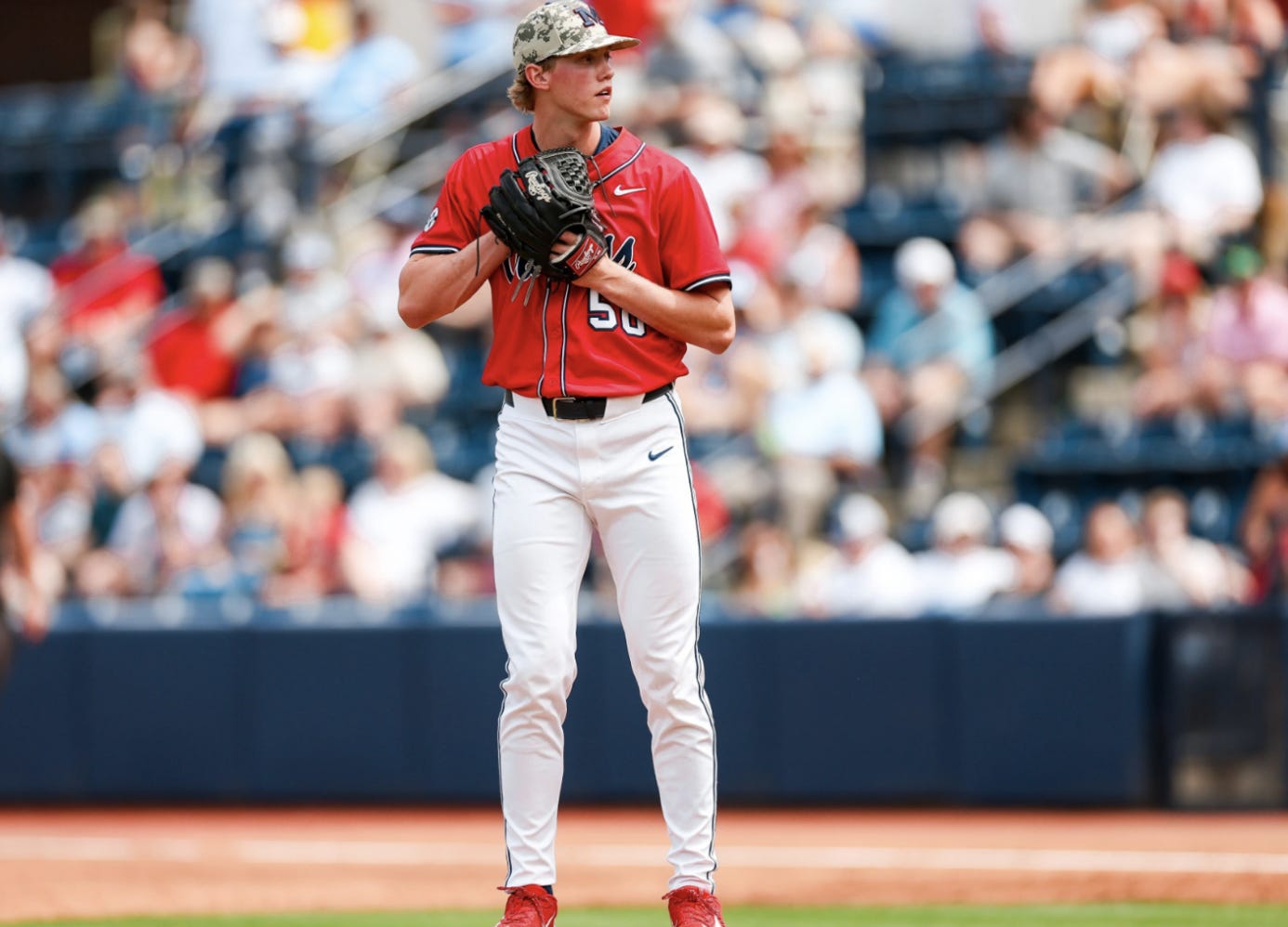
Season: 3-1, 3.16 ERA, 0.93 WHIP — 31 IP, 24 H, 37K / 5BB
Past Week: 6.0 IP, 2 H, 2 R, 1 BB, 5 K
Taylor Rabe jumps into the top 10 and continues to solidify Ole Miss’s rotation.
In Game 3 against LSU, he was dominant early—didn’t give up a hit through six innings, before running into a little trouble in the seventh. He finished with six innings, two hits, two runs, one walk, and five strikeouts.
It’s pretty scary that all three Ole Miss starters are showing up at this level right now.
On the year, he’s 3-1 with a 3.16 ERA and a 0.93 WHIP, and continues to transition from the bullpen into a starting role. The stuff is some of the most electric in the league, and he’s starting to harness it.
11. Alex Petrovic — Auburn (↑ from No. 15)
Season: 6-1, 2.66 ERA, 0.93 WHIP — 47 IP, 35 H, 53K / 9BB
Past Week: 7.0 IP, 5 H, 0 R, 0 BB, 8 K
Alex Petrovic continues to be a dominant force on Sundays for Auburn.
He went seven innings this weekend, gave up five hits, didn’t allow a run, had eight strikeouts, and didn’t walk a batter. He just continues to fill up the zone and rack up wins on the weekends for Auburn.
On the season, he’s 6-1 with a 2.66 ERA and a 0.93 WHIP in 47 innings, allowing just 35 hits with a 53-to-9 strikeout-to-walk ratio.
12. Dylan Vigue — Georgia (↑ from No. 18)
Season: 3-1, 2.63 ERA, 1.15 WHIP — 41 IP, 23 H, 49K / 24BB
Past Week: 6.0 IP, 2 H, 1 R, 3 BB, 7 K
Dylan Vigue continues to solidify himself in Georgia’s rotation.
He’s bounced back and forth as a swing guy, but it looks like he’s locking into that number two starter role. This weekend, he went six innings, allowed just two hits and one run, struck out seven, and walked three against Florida.
On the season, he’s 3-1 with a 2.63 ERA and has allowed just 23 hits in 41 innings. He’s made the transition from the Big Ten to the SEC really well.
13. Ruger Riojas — Texas (↓ from No. 6)
Season: 4-1, 3.40 ERA — 47.2 IP, 41 H, 72K / 11BB
Past Week: 5.0 IP, 5 H, 5 R, 2 BB, 4 K
Ruger Riojas drops again after a second straight outing where he got hit around a bit.
This weekend, he went five innings, allowed five hits and five runs, walked two, and struck out four. His ERA has now jumped to 3.40 on the year.
Even with that, he still limits base runners overall and continues to profile as an elite Friday night guy for Texas, but this is the first stretch all year where we’ve seen some vulnerability.
14. Tyler Fay — Alabama (↓ from No. 13)
Season: 6-2, 3.79 ERA — 54.2 IP, 36 H, 63K / 14BB
Past Week: 6.0 IP, 4 H, 1 R, 2 BB, 4 K
Tyler Fay continues to be a very strong number one option for Alabama.
Even in a weekend where they got swept, Fay did his job. He went six innings, allowed just four hits and one run, walked two, and struck out four.
On the season, he’s thrown over 54 innings, allowed just 36 hits, and has a 63-to-14 strikeout-to-walk ratio. He continues to look the part of a Friday night starter.
15. Liam Peterson — Florida (↑ from No. 22)
Season: 1-2, 3.60 ERA, 1.36 WHIP — 45 IP, 36 H, 66K / 25BB
Past Week: 7.0 IP, 8 H, 1 R, 0 BB, 4 K
Liam Peterson had a really nice bounce-back outing this weekend.
In his first Saturday start for Florida against a really good Georgia offense, he went seven innings, scattered eight hits, allowed just one run, and—most importantly—did not walk a batter.
We’ve talked about his command being the biggest factor for him, and this weekend showed exactly what he looks like when he has it. No walks allowed him to go deeper into the game and put Florida in a great position for the weekend.
On the year, he’s 1-2 with a 3.60 ERA and continues to show one of the highest ceilings in the SEC.
16. Aiden Sims — Texas A&M (↓ from No. 8)
Season: 6-0, 3.56 ERA, 1.06 WHIP — 48 IP, 36 H, 51K / 15BB
Past Week: 4.2 IP, 4 H, 3 R, 2 BB, 3 K
Aiden Sims continues to be Texas A&M’s solid number two starter.
This weekend against a really good Texas team, he did get hit around a bit but limited damage. He went four and two-thirds innings, allowed four hits and three runs, had three strikeouts and two walks.
On the season, though, he’s put together a really strong body of work. He’s 6-0 with a 3.56 ERA and a 1.06 WHIP in 48 innings, allowing just 36 hits with a 51-to-15 strikeout-to-walk ratio. He continues to complement that elite A&M offense perfectly.
17. Landon Mack — Tennessee (↓ from No. 9)
Season: 3-2, 3.75 ERA — 48 IP, 50 H, 64K / 17BB
Past Week: 4.0 IP, 6 H, 3 R, 0 BB, 6 K
Landon Mack is now the Friday night starter for Tennessee and continues to show why.
He went into Mississippi State this weekend and looked solid. Tennessee clearly had a plan to get through the lineup once or twice with Mack and then go quickly to Appenzeller—and that’s exactly what they did.
Mack did his job. He went four innings, scattered six hits, allowed three runs, didn’t walk a batter, and struck out six in a hostile environment. He set the tone for a series-opening win that led to a sweep.
On the season, he’s 3-2 with a 3.75 ERA in 48 innings with a 64-to-17 strikeout-to-walk ratio.
18. Hunter Elliott — Ole Miss (↑ from No. 20)
Season: 3-1, 3.69 ERA — 46.1 IP, 37 H, 68K / 27BB
Past Week: 6.0 IP, 8 H, 2 R, 1 BB, 8 K
Hunter Elliott put together a really strong outing this weekend against LSU.
After walking the first hitter of the game, he settled in nicely and didn’t walk another batter the rest of the outing. He went six innings, scattered eight hits, allowed two runs, and struck out eight.
He led the charge for Ole Miss in a weekend sweep, and when he’s limiting walks like that, he’s as good as anyone on Friday night.
On the season, he’s 3-1 with a 3.69 ERA in 46 innings, with 68 strikeouts. If he continues to hone in the command, his combination of stuff, experience, and competitiveness makes him one of the toughest matchups in the league.
19. Dylan Volantis — Texas (↓ from No. 12)
Season: (unchanged from prior week — did not pitch)
This is a respect spot for Dylan Volantis.
He didn’t get a chance to start this weekend because Texas’s third game was rained out, but I can’t take him out of the top 25 based on his body of work.
If he had pitched and performed well, he could easily be much higher. He’s been one of the more reliable arms in the SEC all year, and this is more about where I trust him going into the second half.
20. LJ Mercurius — Oklahoma (↑ from No. 23)
Season: 5-4, 4.98 ERA — 43.1 IP, 39 H, 62K / 15BB
Past Week: 6.1 IP, 5 H, 3 R, 1 BB, 13 K
LJ Mercurius bounces back after two really tough outings.
He dominated early this weekend against Vanderbilt, going six and a third innings, allowing five hits and three runs (with some inherited runners scoring), and striking out 13.
The swing-and-miss stuff looked like it did earlier in the year, and this was a start he badly needed.
Even though the bullpen couldn’t hold it, this was a really positive sign for Oklahoma moving forward.
21. Tegan Kuhns — Tennessee (↑ from outside Top 25)
Season: 2-3, 3.77 ERA, 1.13 WHIP — 45 IP, 42 H, 54K / 9BB
Past Week: 6.0 IP, 4 H, 2 R, 1 BB, 7 K
Tegan Kuhns is back in the rotation for Tennessee and continues to produce.
He had a really solid outing at Mississippi State, going six innings, allowing four hits and two runs, striking out seven, and walking just one.
On the season, he’s 2-3 with a 3.77 ERA, but the 54-to-9 strikeout-to-walk ratio stands out. He continues to look like a top-50 draft prospect with elite upside.
22. William Schmidt — LSU (↓ from No. 11)
Season: 4-3, 3.22 ERA, 1.19 WHIP — 44.1 IP, 35 H, 63K / 18BB
Past Week: 3.2 IP, 3 H, 4 R, 4 BB, 7 K
William Schmidt struggled a bit at Ole Miss this weekend, but the stuff might have been the best it’s looked all year.
He was consistently 96–98 mph, and his average fastball was up a full tick. But for some reason, he leaned more on the slider than the fastball (see more below), which seemed to put him in some bad counts and led to walks and damage.
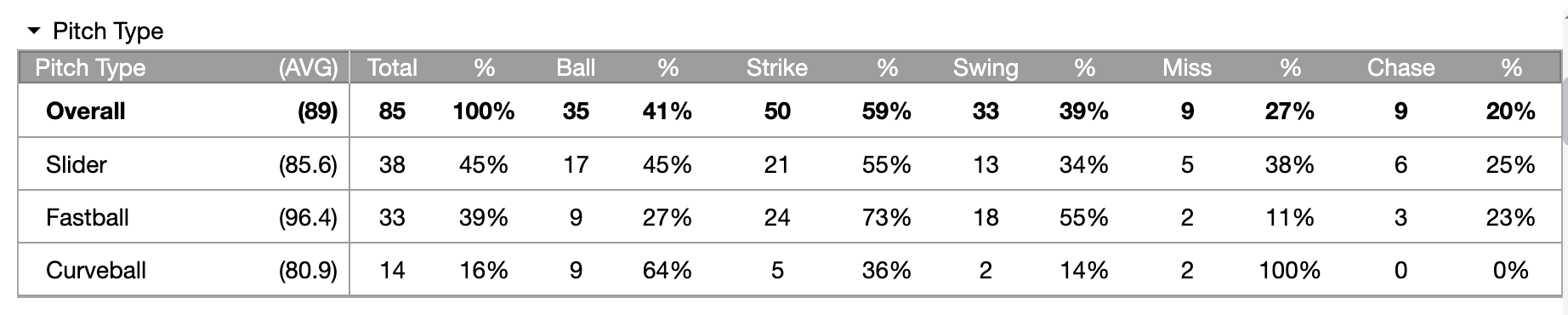
He went three and two-thirds innings, allowed four runs, struck out seven, but walked four.
On the season, he’s 4-3 with a 3.22 ERA. The stuff is trending up, but the pitch usage and command will determine how high he climbs in the second half.
23. Zane Adams — Alabama (↓ from No. 17)
Season: 4-2, 4.13 ERA, 1.23 WHIP — 48 IP, 46 H, 52K / 13BB
Past Week: 6.0 IP, 5 H, 4 R (3 ER), 2 BB, 4 K
Zane Adams continues to provide quality starts for Alabama.
He went six innings this weekend, allowed five hits and four runs (three earned), and continues to be a very reliable number two option behind Tyler Fay.
As Alabama pushes toward the postseason, that one-two punch is a big strength.
24. Shane Sdao — Texas A&M (↑ from No. 25)
Season: 3-2, 5.77 ERA — 48.1 IP, 57 H, 58K / 12BB
Past Week: 4.0 IP, 5 H, 4 R, 3 BB, 6 K
Shane Sdao remains in this group because of fit more than pure numbers.
He pitched against Texas this weekend and was solid enough to start the weekend strong. The ERA and hit totals are high, but he throws strikes and gives A&M innings.
With that offense, that matters. He may give up hits, but he doesn’t beat himself with walks, and that’s why he continues to profile as the right Friday night starter for them.
25. Connor Fennell — Vanderbilt (↑ from outside Top 25)
Season: 3-1, 5.15 ERA — 46 H allowed, 67K / 12BB
Past Week: 7.1 IP, 7 H, 3 R, 0 BB, 10 K
Connor Fennell had a really nice bounce-back outing this weekend.
He went seven and a third innings, scattered seven hits, allowed three runs, didn’t walk a batter, and struck out 10. Early in the game, he was going head-to-head with LJ Mercurius in a really strong pitching matchup.
On the season, the ERA is still elevated, but the strikeout-to-walk ratio is excellent. This is the version of Fennell Vanderbilt needs on Friday nights.
Around the League — Notes, Trends & Developing Arms
I don’t even want to call this an “honorable mention” section, because a lot of these guys are either right on the edge of the Top 25 or are playing really important roles on really good teams. So this is more about just giving these arms the recognition they deserve and highlighting what’s going on around the league.
Casan Evans for LSU continues to develop into a legitimate Friday night option for them. I really like the way he’s trending and how he’s growing into that role, giving them someone they can trust in Game 1. My only concern right now is pitching calling/sequencing and maybe a slight drop in velocity, especially the second and third time through the order. Nothing alarming, but something I’m watching closely, and the reason he just missed the Top 25 for me this week.
Josh McDevitt continues to be a solid Game 1 option for Missouri. Obviously, they’re not one of the top teams in the league, but I don’t want his starts to go unnoticed because his body of work this season has been strong and he’s consistently given them a chance.
Evan Blanco is part of what I think is one of the top two or three rotations in the SEC with Tennessee. He might not have the flashiest or most electric stuff, but he’s a competitor, he’s experienced, and he just knows how to pitch. On a lot of other teams, he’s probably a Friday or Saturday guy.
Myles Upchurch had a really nice outing this weekend for Alabama, and his upside is what excites me the most. As a true freshman in this league, he’s handled himself really well, and his numbers and overall body of work for Year 1 are really impressive.
Matt Scott continues to be a really solid option for Georgia. He got the start on Sunday this weekend, and while it wasn’t his best outing, his role and what he means to that pitching staff is important. Georgia continues to mix and match, and he’s a big part of that flexibility.
Brandon Stone has now moved into the number one starting role for South Carolina and had another solid outing this weekend that set the tone for their series sweep. He was really close to landing in the Top 25 for me. His ERA and overall numbers are very strong, and he’s definitely someone I’ll be watching closely going forward.
Cold Notes & Things to Watch
There are also a few situations around the league that we have to talk about, even if they’re not the most fun.
Cam Johnson struggled with command again this weekend and didn’t get out of the first inning. That one is tough for me because I really like him and think his upside is tremendous. But right now, it’s clearly a command—and probably mental—battle when it comes to throwing strikes.
Kentucky’s rotation is becoming a bit of a concern. Ben Cleaver and Nate Harris have been very up and down—Jekyll and Hyde—and it’s hard to know what you’re going to get start to start. That inconsistency is something to monitor as we head into the second half.
Arkansas is doing something really interesting with their pitching staff. Gabe Gackle came out of the bullpen this weekend and picked up two wins, which is a notable shift. At the same time, Cole Gibler started Game 2 and Tate McGuire started Game 3. They swept the series, so clearly it worked—but it’s something to watch in terms of how they continue to deploy their arms.
Florida’s Sunday situation is also worth keeping an eye on. Russell Sandefer had a tough outing this weekend, but his overall body of work has been solid. If he continues to develop, that could stabilize that third spot in their rotation.
And then for Texas, Luke Harrison—who’s been really steady all year—had a tough outing and didn’t make it out of the first inning. Just one of those weekends, but something to note given how consistent he’s been up to this point.
Final Thoughts — The Separation Point
At the halfway point of SEC play, this is where things start to get real.
The numbers matter. The results matter. But more than anything, roles start to solidify.
You start to see who the true Friday night guys are.
Who can go win you a series opener.
Who can stop momentum.
And who you trust when everything is on the line.
At the same time, you also start to see the cracks.
Which rotations have real depth.
Which teams are piecing it together.
Which programs are leaning on swing arms, matchups, and high-leverage bullpen pieces just to get through a weekend.
Because in this league, it’s not just about having one guy.
It’s about getting 27 outs, three different ways.
And that’s what makes the SEC different.
What’s Next
With five weeks in the books and a full sample size now established, the next step is zooming out.
The rest of this week, we’re shifting the focus from individual arms to the bigger picture:
SEC Pitching Staff Power Rankings (1–16)
We’re going to break down:
Which staffs have true weekend stability
Which teams are surviving with depth and flexibility
How bullpens are being deployed in high-leverage situations
And which programs are best positioned to win series down the stretch
Because at this point in the season, pitching staffs—not just starters—win championships.
And we’re finally at the point where we have enough information to start projecting exactly how that plays out.